(SI) Metamaterials 2026 @ New York
1. The Tight-binding Model
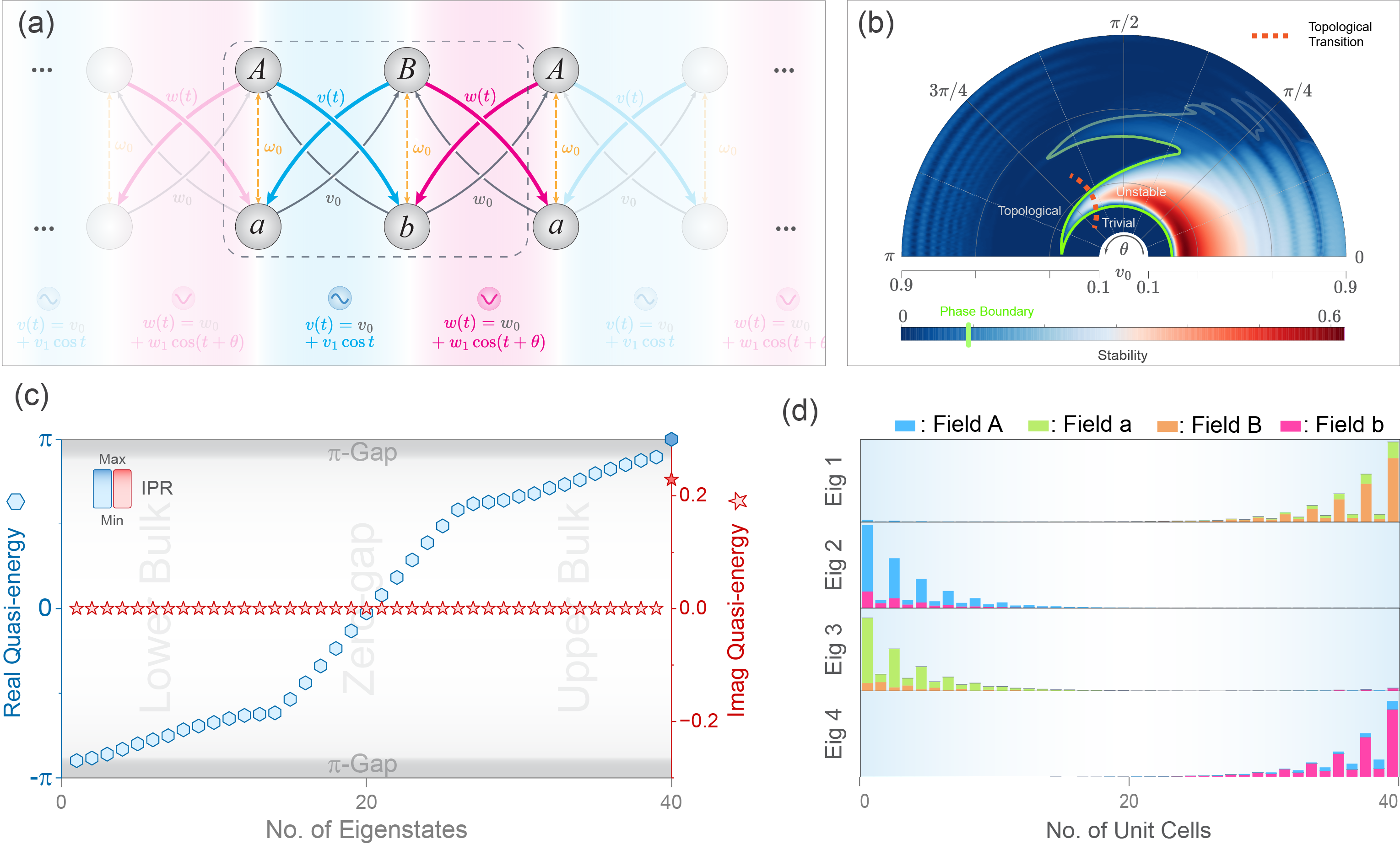
To help understand the physics behind, we developed a phenomenological tight-binding model before the scattering model. It captures the symmetry-protected topological phase (D-class topological insulators), as well as the non-unitary nature of this time-modulated system (parametric instability). (see Fig. 1(a))
- The model has a dual Floquet Su-Schrieffer-Heeger (SSH) chain, where the nearest couplings are modulated at two different phases.
- At the same time, only the upper-to-lower coupling is modulated, just like the practice that only permittivity \(\epsilon(t)\) (or capacitance \(C(t)\)) is modulated in many time-varying systems.
The phase diagram is then calculated using the tight-binding model (see Fig. 1(b)). Only two parameters are swept
- Static Coupling \(v_0=w_0\): This changes the static bandwidth, and determines whether Floquet replicas intersect.
- Staggered Phase \(\theta\): This affects both the parametric stability and the topological property.
We can tell from the phase diagram that
- \(\theta=\pi\), nearest neighbors are anti-symmetrically modulated: Unstable phase as a line between the trivial and topological phase.
- \(\theta = 0\), nearest neighbors are symmetrically modulated: Almost always unstable outside the trivial phase.
- \(\theta\in(0,\pi)\), mixed modulation: Topological, trivial and unstable phases coexist.
The bulk-edge correspondence kicks in either when one chain is bounded by vacuum or when there is an interface between two chains. Parametrically amplified/attenuated edge states will arise in the Floquet \(\pi\)-gap, since connecting two topologically-distinct phases needs to close the gap and cross the unstable phase (see Fig. 1(c)(d)).
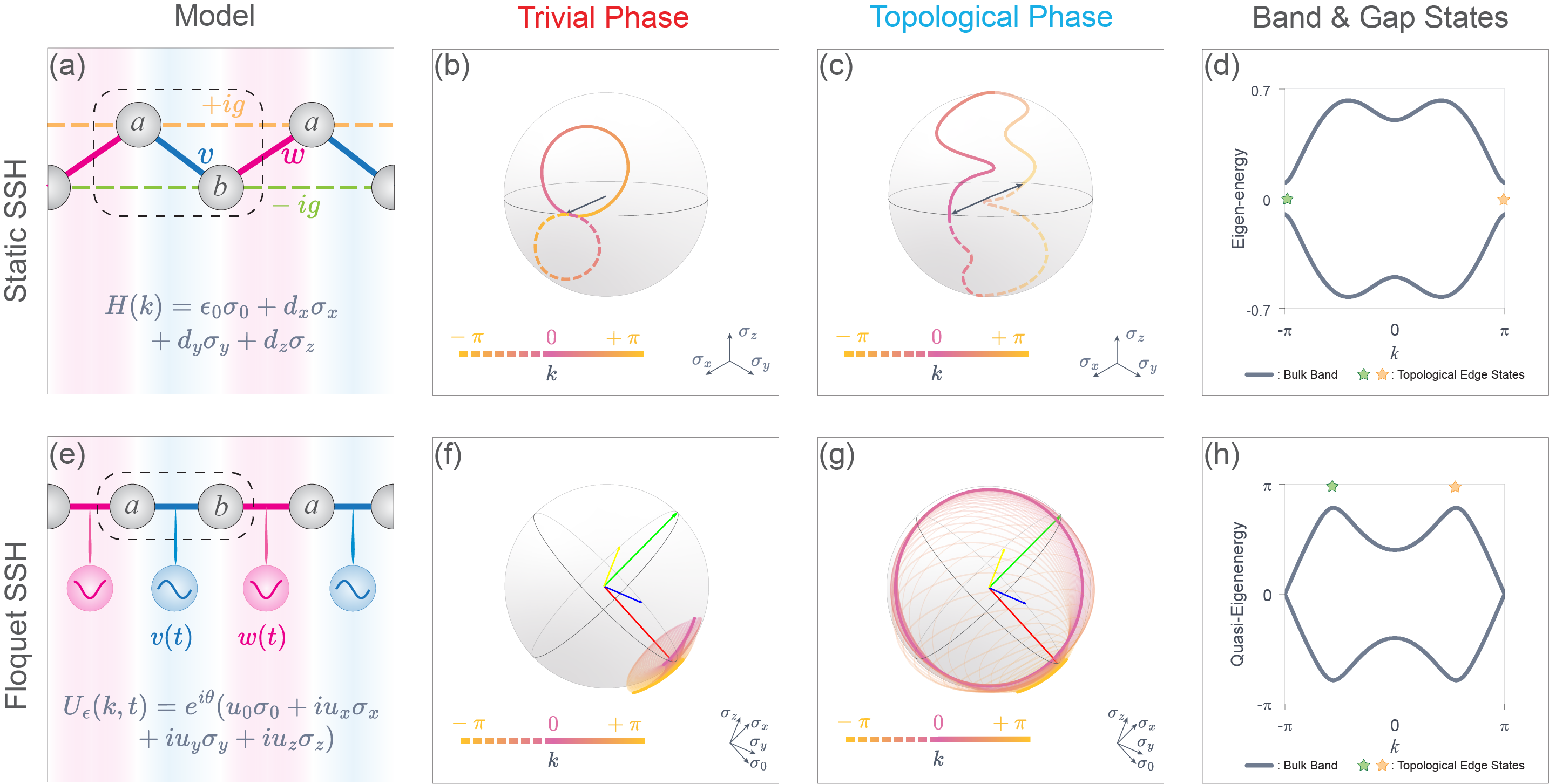
Another noteworthy point is the 10-fold symmetry class of this Floquet SSH model. When \(\theta=0,\pi\), the modulation still preserves both chiral and particle-hole symmetry and the model falls into BDI-class. Nevertheless, for general cases where \(\theta\in(0,\pi)\), chiral symmetry breaks and the model only has particle-hole symmetry, which falls into D-class. For 1D Floquet D-class insulators, the \(\mathbb{Z}_2\) invariant is then defined at symmetric points in \(k\)-space as an analog to static D-class insulators.
2. More On the FDTD Package
To fulfill the demand of high-performance full-wave simulations of time-varying and nonlinear EM systems, we developed a CUDA FDTD package on the basis of openEMS, an open-source C++ package for FDTD simulation. Our modified package features full support for time-varying (TV) components, Bloch boundary conditions (BBC), uniaxial perfectly matched layers (UPMLs) and complex frequency-shifted convolution perfectly matched layer (CFS-CPMLs). A full FDTD-SPICE workflow will be progressively introduced in the future, which could give more freedom to researchers working on the frontier electromagnetic problems.
With GPU-oriented optimization such as FP4/8/16 codebook quantization, batched engines for parameter sweeping, adaptive memory layout and CUDA graph record/replay, this engine finally achieves considerably high Yee cell rates, e.g. ~16GC/s PEC/PMC only (tested locally, Nvidia RTX 4070SUPER) and ~8GC/s in the presence of BBC/PML/TV-RLC (tested on the EPFL-SCITAS KUMA cluster, Nvidia H100). (See Fig. 3)

3. Temporal Field Evolution In the Duo-modulator Unit Cell
With the 3D full-wave FDTD package, we manage to extract the frequency-preserved (@1.5 GHz) scattering element from a Floquet system, where two modulators are modulated at 3 GHz with different phases. The following videos show how the field \(E_z\) in the structure evolves when modulation phases vary.
Case 1: Static case Case 2: Anti-symmetric modulation Case 3: Symmetric modulation
4. Experimental Measurement of the Edge States
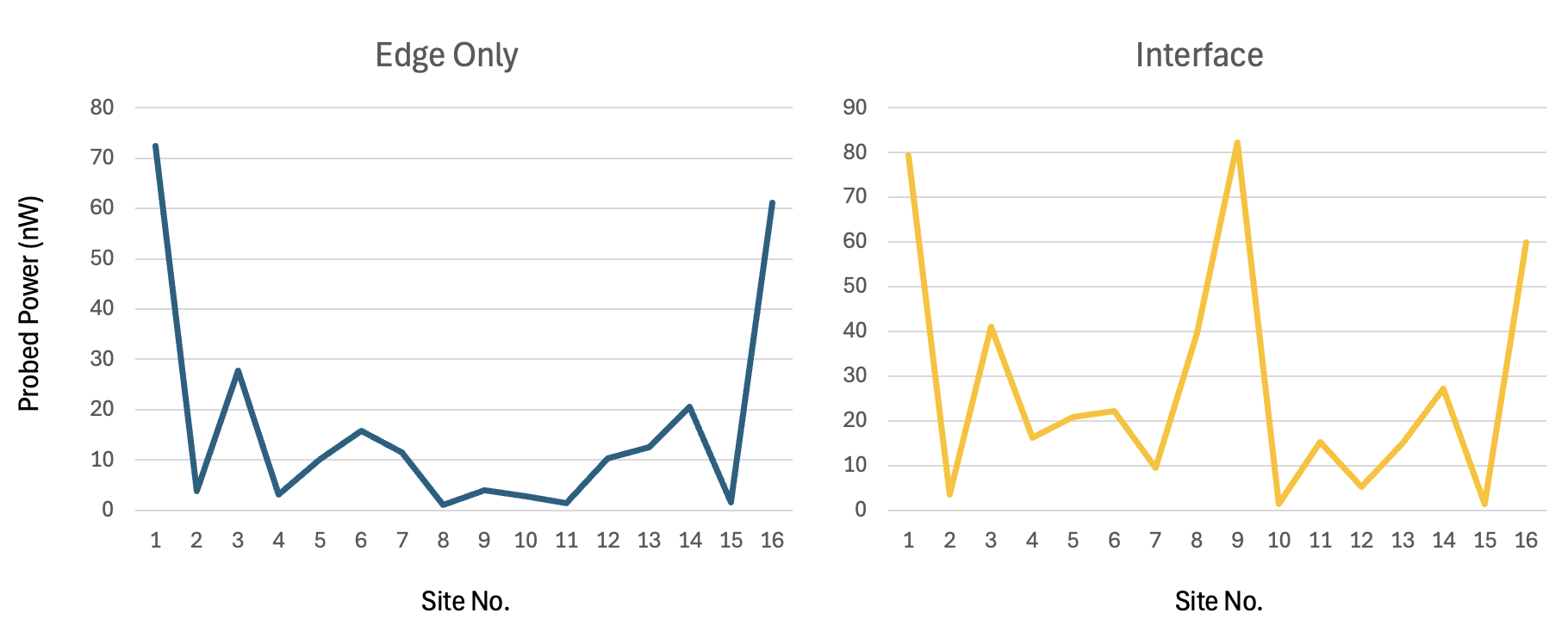
These are some preliminary experimental results (still undergoing)